Posted on June 23rd, 2011
 As gastric bypass surgery becomes more mainstream, with more than 200,000 people each year choosing the procedure each year – from celebrities like Al Roker and Carnie Wilson to the average Joe – research has begun to shine a light on whether it really works for long-term weight loss. Wake Forest researchers find the surgery yields health benefits beyond weight loss. For full article jump to Windows on Wake Forest…
Posted on June 21st, 2011
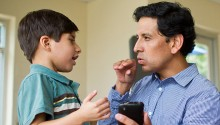 Paul Pauca’s 6-year old son, Victor, suffers from a rare genetic disorder. With a little help from his students, Pauca, a computer science professor, has created “VerbalVictor,” a smartphone app that not only helps his son overcome any communication challenges he faces but one that is already helping other children and their parents as well. Jump to full article at USA Today…
Posted on March 29th, 2011
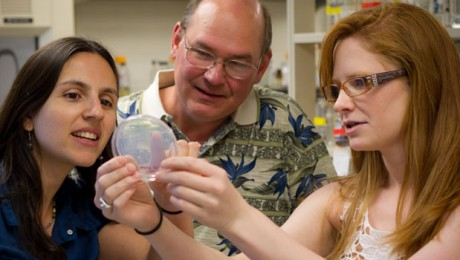 Senior chemistry major Allison Faig and professors Bruce King and Patricia Dos Santos are researching how antibiotics destroy dangerous bacteria in the body — hoping their work will lead to the development of new weapons against disease. Jump to full article at Windows on Wake Forest…
Posted on February 28th, 2011
Being overweight and under-exercised can reduce an older person’s ability to do ordinary daily activities. But people over 65 who lose weight and increase their activity can regain some of what they lost. At Wake Forest University, Jack Rejeski examined data on people in a program to do that. He says those with the least mobility improved as much as 20 percent on one crucial test – the time it took to walk around 1,300 feet. The study in Archives of Internal Medicine was supported by the National Institutes of Health. Learn more at hhs.gov.
“The best thing, in my opinion, that any older adult can do is watch their weight and be active, so they move as far away from disability as they possibly can.’’ To hear more of the interview between HHS Healthbeat correspondant Ira Dreyfuss and Dr. Jack Rejeski jump to Mixdown Weighing less, moving more
Posted on January 25th, 2011
 Walking more and losing weight can improve mobility as much as 20 percent in older, obese adults with poor cardiovascular health, according to a new Wake Forest study. The results from the five-year study of 288 participants appear Jan. 24 in the Archives of Internal Medicine. Jump to full article at: http://news.wfu.edu/2011/01/24/weight-loss-plus-walking-helps-seniors/
Posted on January 20th, 2011
 Health care professionals have not had an easy and effective way to assess the mobility of the elderly. To solve the problem, Wake Forest professors Tony Marsh and Jack Rejeski developed the Mobility Assessment Tool, which uses video animation. Jumpt to full article at: http://news.wfu.edu/2011/01/19/mobility-in-elderly-assessed-through-ipad/
Posted on January 5th, 2011
“Most lists of nutritious super foods don’t include beet juice, but according to recent research it belongs right up there with salmon and blueberries. Beet juice deserves a spot on the list because it may boost stamina to help you exercise longer, improve blood flood, and reduce blood pressure.” Wake Forest researcher Gary Miller, PhD quoted. Jump to full article at: http://www.webmd.com/food-recipes/features/truth-about-beetroot-juice
Posted on November 15th, 2010

Wake Forest researchers have found that beet root juice increases blood flow to the brain.
“Wake Forest researchers have shown for the first time that drinking beet juice can increase blood flow to the brain in older adults – a finding that could hold great potential for combating the progression of dementia.” Jump to the full article at Window on Wake Forest…
Posted on September 10th, 2010

Muday with students in her research garden (credit: Window on Wake Forest)
“Wake Forest University’s Campus Garden overflows with tomatoes. But, with names like Never Ripe and Green Ripe, many will never be the rich, red orbs you’d slice up for sandwiches. These tomatoes – mutant varieties bred for research – will help Gloria K. Muday, Ph.D., a professor of biology, determine how the hormone ethylene can inhibit or aid root development.” Jump to the full article at Window on Wake Forest…
Posted on June 21st, 2010

Physics professor Daniel Kim-Shapiro is studying how nitric oxide in blood affects the quality of stored blood. (credit: WFU News Center)
“The National Heart, Lung, and Blood Institute (NHLBI) of the National Institutes of Health, announced today that it will fund nine research grants to improve the safety of red blood cell transfusions. Professor of Physics Daniel Kim-Shapiro and a collaborator at the University of Pittsburgh have been awarded a $2.8 million, four-year grant to study why the quality of stored blood degrades over time and to investigate ways to make transfusions using older blood safer.” Jump to the full article, originally published 6/21/10, on WFU News Center…


